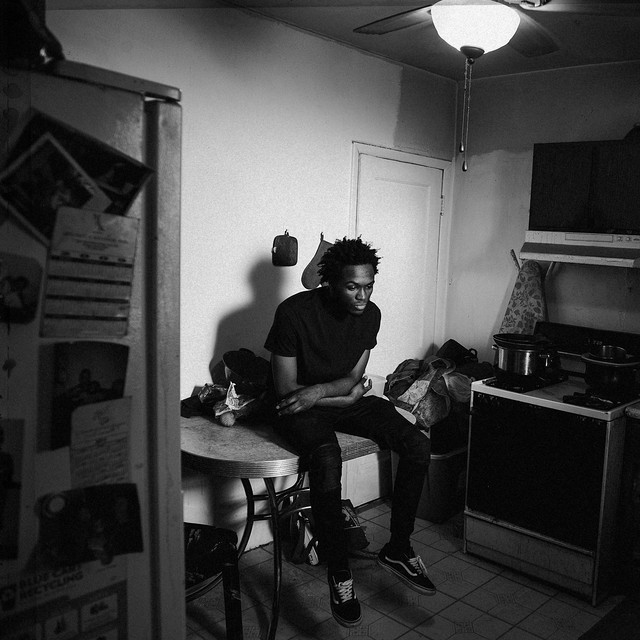
Eight years later, ‘CARE FOR ME’ still doesn’t feel like an album you simply “revisit.” It feels like something you return to when you need it.
When Saba released the project in 2018, it arrived quietly, almost understated. No grand rollout, no forced moment. But what followed was something much heavier: a body of work shaped by grief, reflection, and survival, rooted deeply in Chicago and the loss of his cousin and collaborator John Walt of Pivot Gang. That context isn’t just background information, it is the album.
From the opening moments, ‘CARE FOR ME’ establishes a tone that never breaks. There’s a stillness to it, but also tension. Saba doesn’t rush anything. He lets thoughts breathe, lets emotions sit, and trusts the listener to follow. That patience is exactly what makes the storytelling hit the way it does.
Tracks like “BUSY / SIRENS” and “PROM / KING” don’t just tell stories, they unfold them. Slowly, precisely, almost like memories being processed in real time. Especially on “PROM / KING,” where Saba reconstructs events with a level of detail and control that feels closer to literature than rap. It’s not just what he says, it’s how he structures it. Every line feels intentional, every pause earned.
There’s often a tendency to compare the album to ‘To Pimp a Butterfly’ by Kendrick Lamar, and on some level, that makes sense. Both are deeply personal, culturally grounded, and emotionally dense. Both feel like complete worlds rather than collections of songs. Calling ‘CARE FOR ME’ a “Chicago version” of that level of artistry isn’t far off.
But at the same time, that comparison almost undersells what Saba did here. Because ‘CARE FOR ME’ doesn’t rely on scale or spectacle. It’s smaller, more intimate, more internal. Where TPAB feels like a societal statement, ‘CARE FOR ME’ feels like sitting alone with your thoughts at 2AM, trying to make sense of everything.
The production reflects that too. Minimal, warm, often melancholic, but never empty. There’s a cohesion to the sound that mirrors the writing, nothing feels out of place, nothing feels like filler. The project moves like one continuous thought rather than separate tracks.
What makes the album age the way it has is how honest it remains. There’s no attempt to over-explain or dramatize the pain. Saba doesn’t perform grief, he processes it. And in doing so, he created something that feels timeless, not because it tries to be, but because it’s real. Eight years on, ‘CARE FOR ME’ hasn’t lost any of its weight. If anything, it’s grown into it.
